Shaping of the Next End-of-Year Narrative Begins: Russia Faces "Exhaustion" in 2026
We examine media claims and crunch some numbers to evaluate Russia's prospects for 2026.
The next media narrative is slowly taking shape that Russia is starting to get “exhausted”, which will—naturally—culminate in some kind of breakdown in 2026. This is of course an old narrative repurposed anew now that Ukraine itself is in its least enviable shape ever, with no prospects at all of improvement.
Interestingly, for up to two years now, we have heard from top figures and publications that 2026 would be the “key year” beyond which Russia would no longer be able to sustain itself, and this from several different perspectives. Economically, Russia’s so-called ‘headwinds’ would finally prevail, and its “overheating” economy would begin to see widespread ‘structural breakdowns’ or outright collapse.
Militarily, Russia would have run out of all armor by 2026 and would no longer be able to carry out “maneuver attacks”, while troop recruitment capacity would dwindle, requiring Putin to finally launch that large-scale ‘mobilization’ he’s been putting off for so long, resulting in mass social upheavals and even a coup.
Given that we’re at the end of 2025, it is a fitting time to look ahead at some of these projections, and see where things truly stand for both sides leading into 2026.
Also, of particular significance is the fact that the Ukrainian conflict is approaching a key milestone: on January 11th, 2026 the conflict will have lasted precisely 1,418 days from its onset in February 22, 2022. 1,418 is the exact length of time that the Eastern Front war between Germany and the USSR lasted, from June 22, 1941 to May 8, 1945. And so, to some extents it is only natural that some begin to question the prospects of Russia’s longevity in this conflict.
Many new MSM publications are starting to use the word ‘exhaustion’, the latest being the Sunday Times:
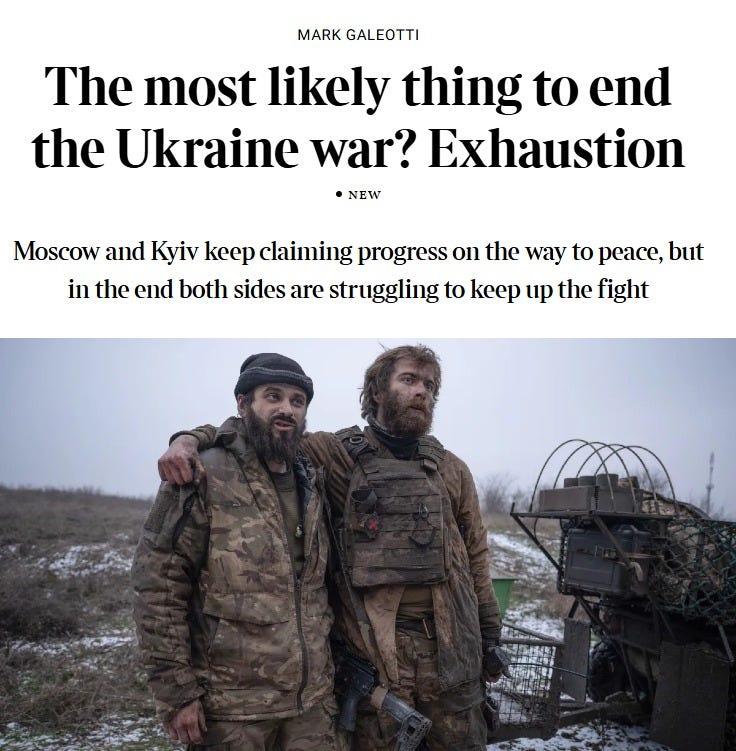
They utilize the now-standard practice of couching Ukraine’s own near-terminal exhaustion in false or exaggerated descriptions of Russia’s selfsame condition. This has been the chief tactic of the West in ever admitting any of Ukraine’s faults or weaknesses: when doing so, always make sure that Russia is accused of suffering from the same or worse, in order to ‘soften the blow’ and not demoralize the Western audience too much; after all, this audience is the one coughing up its hard-earned tax dollars to keep funding the West’s proxy and war machine in one.
Conscription increasingly looks like press ganging. Ukraine’s notorious practice of “busification”, whereby recruiters forcibly round up men of conscription age and bus them to draft offices, has not only led many to flee the country, it is causing a labour shortage in the civilian economy. Desertion is rife, with more than 160,000 open criminal cases, even though in some cases this is simply a way for soldiers to transfer from one unit to the next.
The article above for instance goes down the laundry list of ways Ukrainians are losing optimism and hope for any positive outcome in the war, but then couches it all by claiming that Russia’s economy is losing steam and will “stagnate” in 2026.
One spectacular point of hypocrisy from Western publications can be highlighted here. The article notes that Russia’s economy is only growing on the basis of defense production needs:
GDP officially still grew 1 per cent this year, but that is largely on the basis of war production: building equipment shortly to be destroyed. Although Putin continues to try to talk it up, the underlying economy is already in recession and is likely to stagnate in 2026.
This is obviously characterized as a major weakness. Yet by the same token, the latest Financial Times report proudly declares that all of Europe’s economies depend entirely on German defense spending:
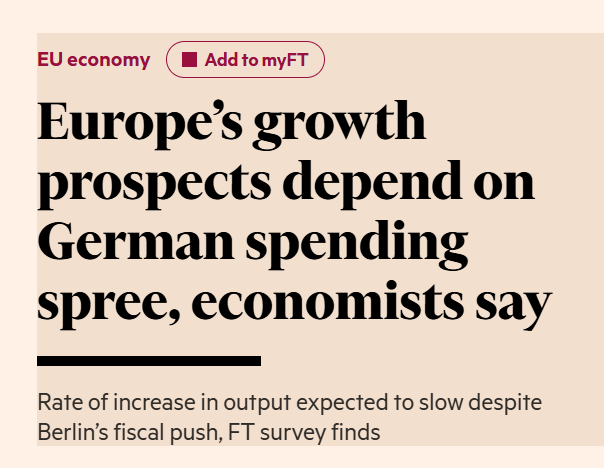
From the opening sentence:
Europe’s hopes of a return to growth in 2026 rest largely on Germany’s €1tn debt-funded spending drive on infrastructure and defence, according to a Financial Times survey.
Yet the 88 economists polled are split over whether Berlin’s fiscal push will deliver a “European renaissance” or fade amid entrenched structural weaknesses and geopolitical uncertainty.
So, Russia’s war-driven economy means Russia is collapsing, but Europe’s war-driven economy heralds a forthcoming renaissance of European economic might….right.
That’s not to even mention the pathetic fact that all of Europe is looking for Germany alone to rescue it, and this all still is somehow meant to compare favorably in optics to singular Russia.
The Times article lazily concludes—without a single real data point of even remotely convincing proof—that this all means Russia will become ‘exhausted’ in 2026, leading to an entirely frozen conflict, of course ignoring the fact that Russia’s advances are literally accelerating to unseen heights:
Even if war continues throughout 2026, though, it will be increasingly hard to sustain at the current level. The choices everyone is going to have to make are getting more painful — for Putin (whether to mobilise reservists) or Zelensky (whether to lower the conscription age).
Even without a deal, the war may decline in tempo and intensity, at least on the ground. As exhaustion sets in, both sides may be willing to accept compromises currently regarded as impossible.
For instance: where do they get that Putin will have to “mobilize reservists”?
Even Ukraine’s Budanov just yesterday again reiterated that Russia is having no issues mobilizing ~410,000 men per year, and will do so again in 2026—this all while many Russian regions are now dropping their recruitment bonuses due to over-subscription. Recall that I’ve previously shared the rumor that 400k+ appears to be the max yearly amount Russia can even handle, with many recruitment offices reportedly turning people away because the training range capacity simply does not exist to train more troops per month than what is already coming in. The closer Russia gets to visibly winning, I suspect, the more recruitment will surge and things could acutely speed up.
There are contrasting takes, however. Azov’s Biletsky just stated that Russia is in fact—for the first time ever—not making up for its losses via recruitment:
Colonel Andriy Biletsky Founder Of Azov Battalion:
"For the first time in a long period, in recent months, according to all intelligence data, including from Western allies, the reinforcement of personnel in the Russian Armed Forces does not outweigh the losses,"
Note his transition to the on-message characterizations of Russian ‘exhaustion’, again couching Ukraine’s own exhaustion with comparisons to Russia suffering “the same” condition:
“We and the Russians are like boxers in the 12th round. We think about our condition and exhaustion, like, "I'm going to collapse now, and that's it." But I think the Russians are more or less in the same condition.”
“The Russians have a catastrophic situation in all major types of weapons, armored vehicles, artillery systems, etc.”
“The Russians are currently much more successful in air strikes against Ukraine than on the front lines.”
“Yes, [Ukraine] has had setbacks, there have been retreats, of course. But how reasonable is the price for this for the Russians?”
“They're running out of steam. The quality of personnel has long been extremely poor, but combat training is also objectively deteriorating further with each passing month”
- Colonel Andriy Biletsky
Recall that this is the only blog where you get an impartial view from both sides, not one-sided partisan propaganda. So we must examine the words and statistics from both ends to properly tune the analysis.
His statement about Russia “running out of steam” on the front is particularly suspect. Just today, the full and total captures of both Gulyaipole and Mirnograd were finally announced. At the same time, new transmissions from Kupyansk suggest that the situation may be improving for Russians there. Ukraine has typically lost one major city per year in prior years: Mariupol in 2022, Bakhmut in 2023, Avdeevka in 2024—though some count Severodonetsk and Lisichansk for 2022 as well.
Now in 2025, Ukraine has lost Pokrovsk, Mirnograd, Seversk, Gulyaipole, and a host of smaller ones such as Velyka Novosilka and Volchansk in the north. A string of cities remain perched to be captured, such as Konstantinovka, Kupyansk, Stepnogorsk, Novopavlovka, and the one likely to go next, given the renewed Russian advances there as of the past two days: Krasny Lyman.
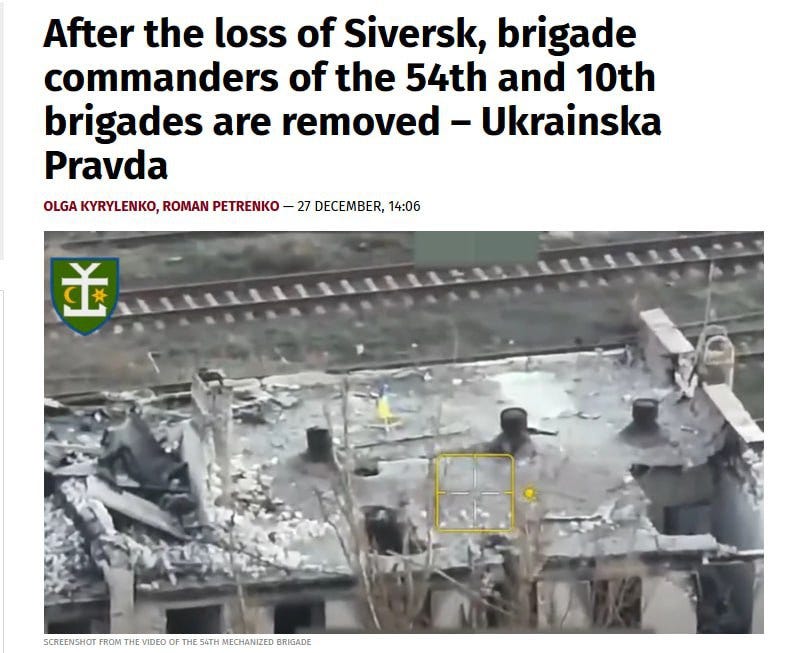
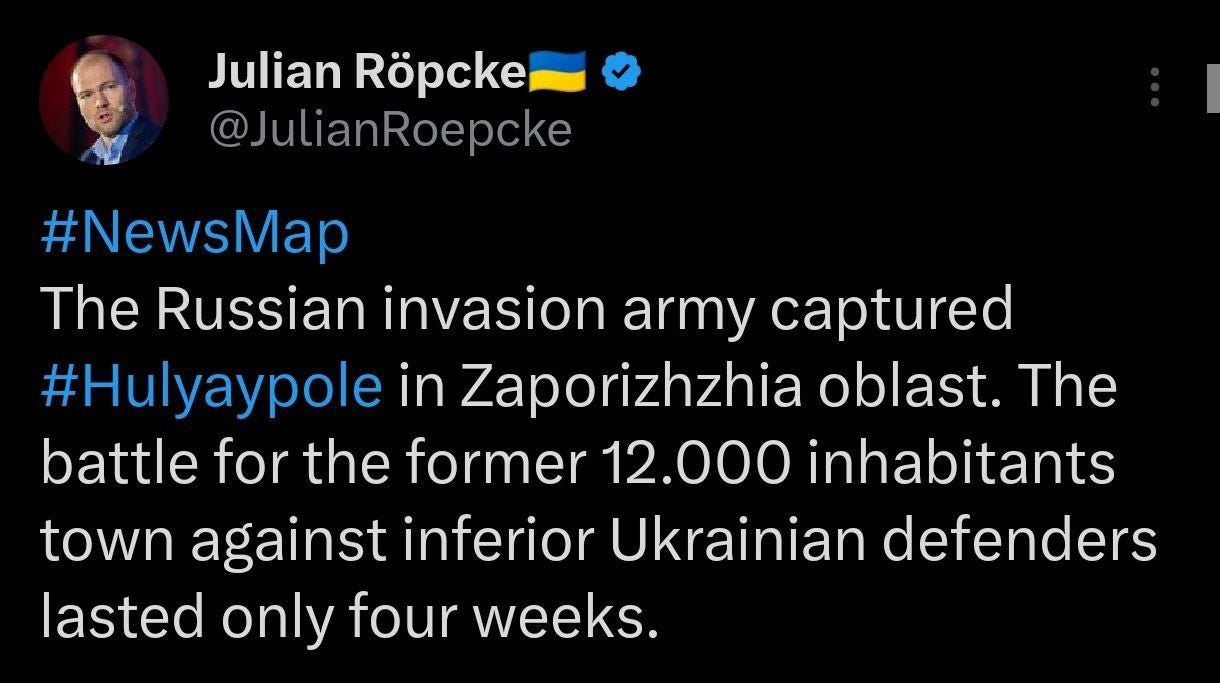
This, contrary to Biletsky’s words, does not indicate a “slow down” of any sort on the front. Even Roepcke is shocked at the recent speed.
By the way, there are two other major problems with Biletsky’s statements. First, he says the following simply absurd line:
The enemy's objective losses are at least 6, sometimes 8 times greater than our losses. We don't have such a large difference in manpower to sustain losses 6-8 times greater and be able to conduct such a campaign for a long time.
Claiming that Russia suffers an unfavorable 8:1 loss ratio to Ukraine simply discredits the remainder of his argument.
What discredits it even more, however, is the fact that a cursory search of his previous statements can find gems like this one from early 2025:
Russia's Army Is Falling Apart: Their 2024 Offensive Capacity Was Wiped Out
In a recent interview with Yanina Sokolova, Andriy Biletsky, founder of the "Azov" Regiment and commander of Ukraine’s 3rd Assault Brigade, stated that Russia has completely burned through its offensive potential from 2024 — and hasn't built a new one.
❝The Russian army today is significantly weaker than it was last year,❞ Biletsky emphasized.
This statement is from June of 2025, long before Russia was poised to capture all the current territories, or truly began its ‘summer offensive’ in full on the Zaporozhye-Dnipro region. Thus, we can see that his previous assessments have already proven flat, which hangs a cloud over his present statements.
Other publications are taking a slightly different approach. Politico likewise invokes the spirit of ‘exhaustion’, but at least accurately identifies the threat that it is Europe and the West being “exhausted”—or in their words, bled dry—by Russia, rather than the other way around:
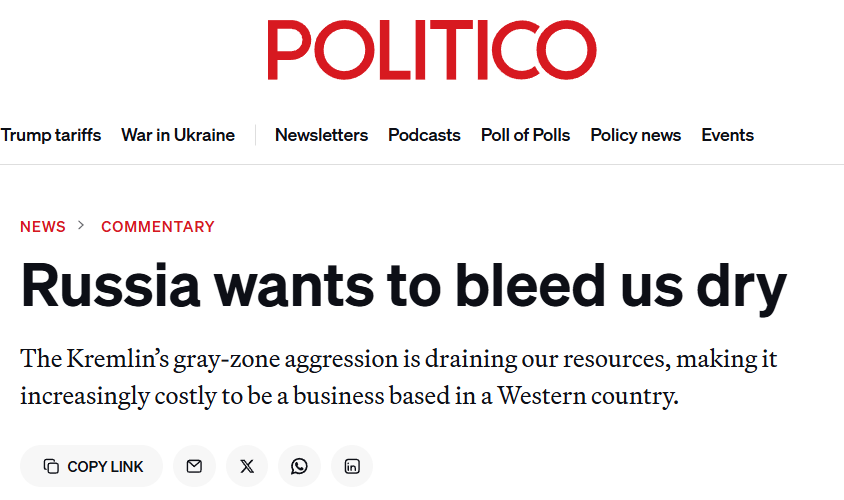
We can see the above in action: politically, Europe has never been weaker, while Russia has never been stronger. There is virtually no political turmoil in Russia at all, and a credible opposition to Putin does not even exist, contrary to previous years where at least a phony candidate like Navalny was still able to be floated by the West, which managed to incite some modest protest and passingly noteworthy action.
Now there is virtually no credible argument to be made for Russia beating Europe in the political race to the bottom. Economically speaking, there are arguments for both sides having various strains. For instance, we know the well-known issues of the EU, particularly with German de-industrialization.
Today, there were reports that Russia is suffering a collapse in industrial production:
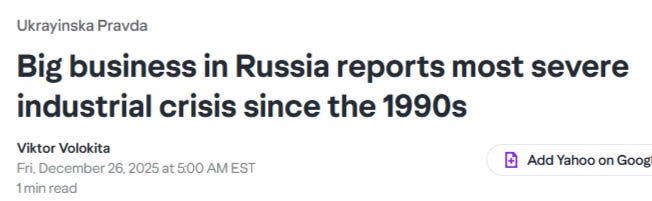
Though the above is sourced from Ukrainian publications, the official stats were posted on Russia’s own federal Rosstat page and cited by Russia’s own TASS service:
Overall, metallurgical production in Russia declined by 4.1% year-on-year in November 2025 and by 0.3% compared with October 2025. At the same time, metallurgical production decreased by 3.8% over the eleven months of 2025.
How big of an issue is that, though? Hard to say, given that Russian sources appear to downplay it, while Western ones naturally do the opposite, vastly over-exaggerating it.
Plus, there are many counter-stories. The Ruble, for instance, was again declared the world’s strongest currency by Bloomberg—though again with the now-obligatory caveat of, “at what cost?”:
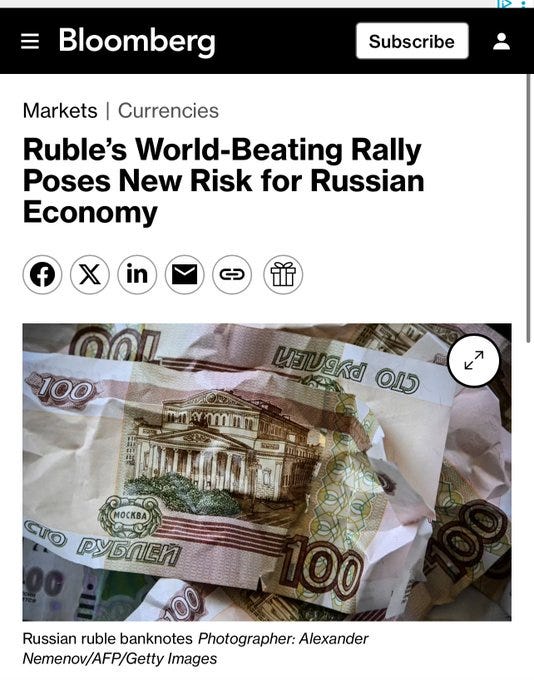
The comparisons to Europe’s economic downturn is arguable—what is not arguable is that the Russian capacity to withstand troubles far exceeds the European one. This is because culturally and civilizationally, Russian people are now peaking in terms of their pride, solidarity, and national unity. Europeans are experiencing the reverse: an absolute nadir period of demoralized distrust of their governments. That means even if the situations are comparable, Russia remains poised to outlast Europe in the ‘race to the bottom’.
In terms of Ukraine, recent figures likewise go both ways. For instance, a new casualty statistic from top Ukrainian channel Gorushko claims that Russian casualties are now peaking at ~2,000 KIA per week:
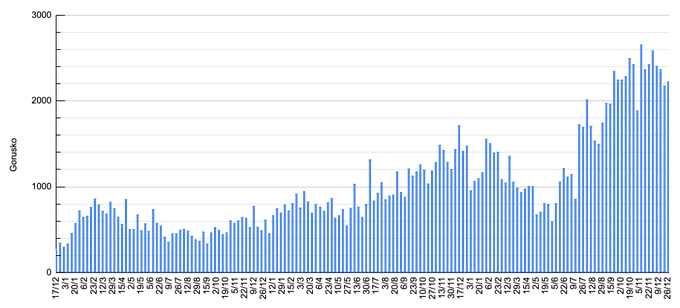
Their methodology reportedly also counts obituaries, like MediaZona.
That said, even if this is true, it represents 8,000 a month for KIA, with a projected equal amount in ‘irreversibly wounded’, for a total of—let’s say—~16,000. Russia’s well-established recruitment of 30,000+ monthly easily covers even that, and this is worst-case scenario only, playing devil’s advocate and taking these reports at face value; Russia’s real losses may be much smaller than that.
Furthermore, the most thorough documenter of vehicular losses, highly caustic Russophobe Andrew Perpetua, recently shared another update in documented losses for December which shows Russia continuing to get the better in exchanges:
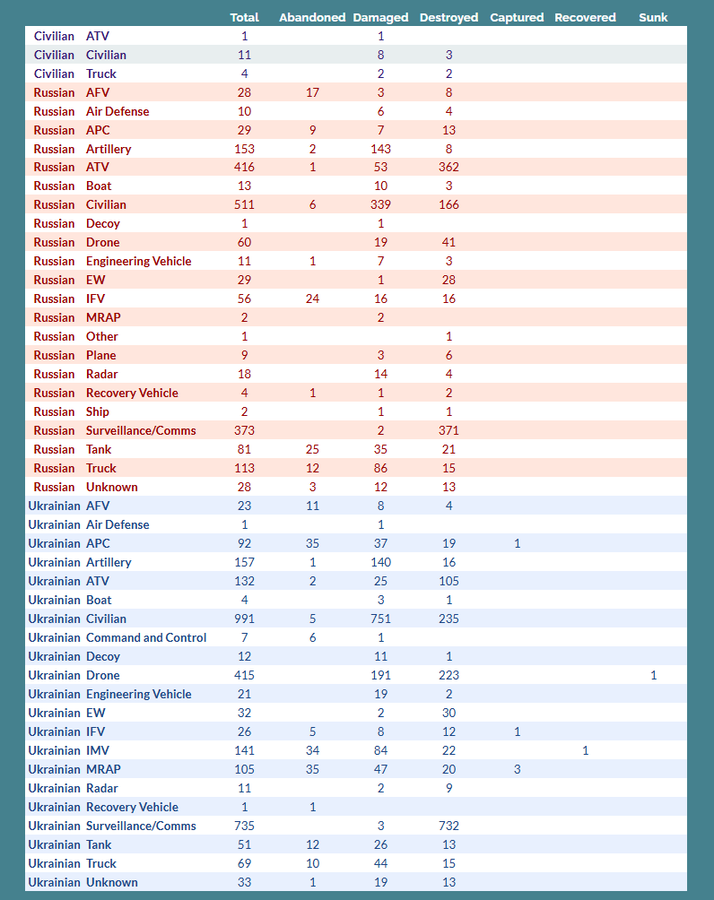
The breakdown of equipment losses for December 2025 shows a worrying pattern for Ukraine.
While on the defensive, Ukraine has managed to lose more equipment than Russia. This is a trend I noticed during the summertime.
These are the "important" frontline numbers:
Russia:
Armoured vehicles - 115
Tanks- 81
Artillery- 153
Logistical vehicles - 1,040
Ukraine:
Armoured vehicles - 387
Tanks- 51
Artillery- 157
Logistical Vehicles - 1,192
Ratios:
Armoured vehicles - 1:3.3 (Russia's favor)
Tanks - 1:1.5 (Ukraine's favor)
Artillery - basically 1:1 ratio
Logistical vehicles - 1:1.1 (Slightly in Russia's favor)
These are the losses only visually confirmed. The count comes from a very pro-Ukranian source: Andrew Perpetua.
The Warspotting account finds that Russia’s equipment losses for 2025 are at 60% of what they were in 2024—from an X write-up:
Warspotting shows equipment losses are about 60% of 2024 (when you factor in lag time and an additional 500 or so to come). Tanks are at 519 this year vs 1139 last, and AFVs are at 1316 this year vs 3073 last.
In his recent visit to the front, Putin doubled down with even more fervor than usual, giving his boldest statement yet on the disposition of Russia’s military. He said that due to the speed of Russia’s recent advances, Russia now has zero interest in seeing the AFU voluntarily withdraw from the occupied territories, which Russia will now take by force anyway:
One paraphrasing for clarity: “Putin: As the pace of advance accelerates, the offer for Ukraine to withdraw from four regions—on the table since June 2024—has effectively become obsolete. Russia will achieve all its objectives by force.”
If we are to understand Putin’s words correctly, that means he’s no longer playing “Mr. Nice Guy”, and could care less about previous offers of olive branches and “gestures of good will”. Clearly, knowing the internal numbers and capabilities of the Russian Armed Forces and economy, Putin believes more confidently than ever that Russia will continue prosecuting its offensives unhindered into 2026.
German paper Die Welt echoed this sentiment with their latest piece yesterday, entitled “Painful Truths”:
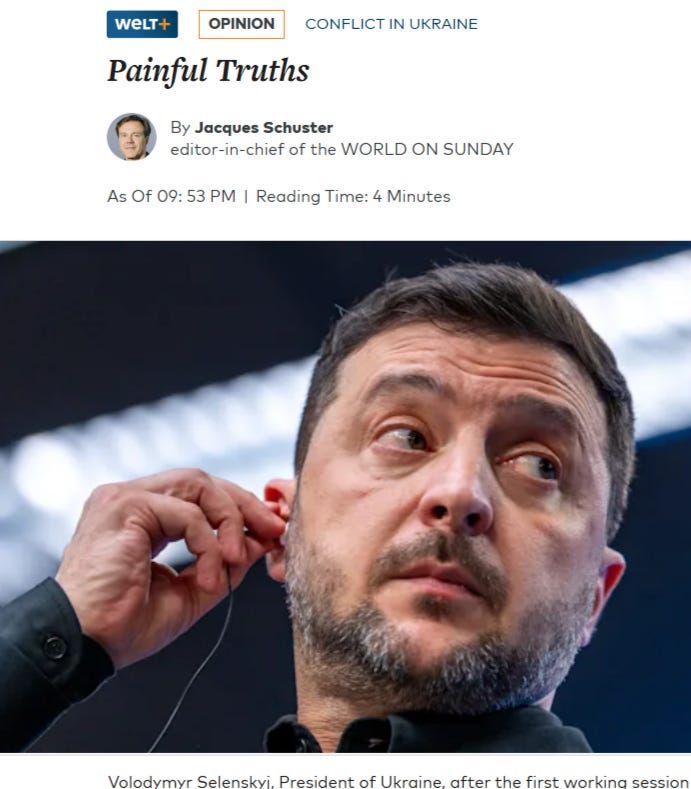
From the opening sentence, it starts on a painfully candid note:
Ukraine will lose the war against Russia—Europeans must admit this, even if it hurts. The only thing that matters now is preventing the worst from happening.
It is time to face the facts – soberly, relentlessly, painfully. Ukraine will lose the war against Russia. The country is embroiled in a war of attrition against the Russian aggressor, which is slowly but surely sapping its strength.
The article goes on to run through the litany of unfavorable Ukrainian developments, which include dwindling aid.
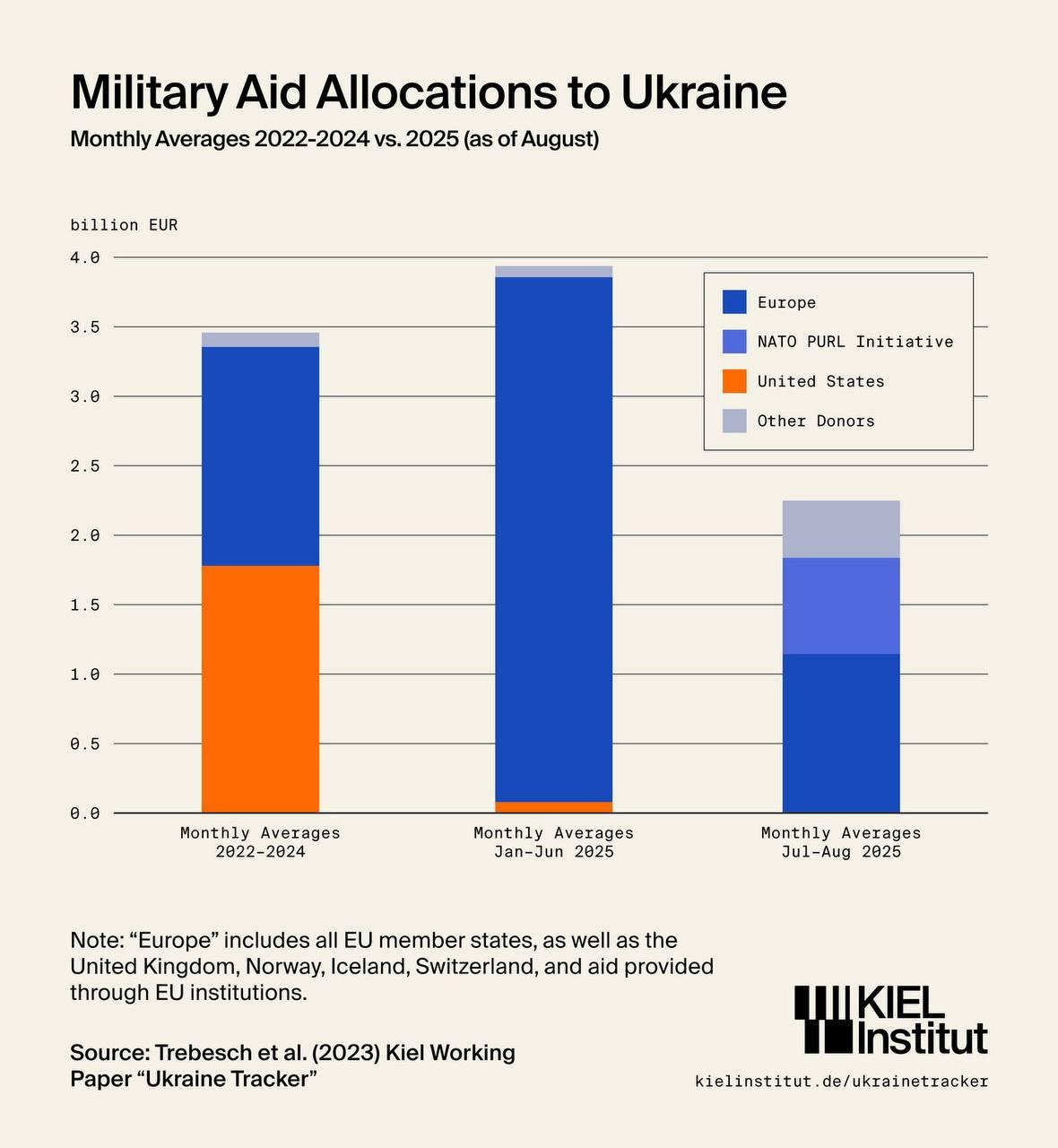
Moreover, Kiev is facing national bankruptcy. The Europeans have provided €20 billion in bilateral economic aid over almost four years. According to the International Monetary Fund, that is one-third of what Ukraine needs to maintain its statehood. The new €90 billion loan from the EU will give Kiev some breathing space for a while. But what will happen after that?
Shockingly, the Welt authors go on to—whether unwittingly or not—justify Russia’s existential war with a clarity rarely witnessed in Western rags:
Putin sees Europe’s weakness with icy coldness
The war will not be over even after that. Russia will continue to fight, no matter how much Europeans enjoy the sound of their own echoes. It may seem laughable and absurd (and it is!), but Moscow sees its war of aggression against Ukraine as a fight for its own existence. It feels surrounded by NATO, sees itself in a stranglehold due to the Atlantic Alliance’s eastward expansion, and will not be deterred from advancing—if necessary, meter by meter, year after year. It will stick to this course. Psychiatrists know that no matter how kindly and reasonably you explain to paranoid patients that their fears are delusional, they will not abandon their delusions, no matter how much they themselves suffer from them.
Of course, they sully their own insightfulness by then crudely dismissing these NATO threats as mere psychiatric “delusions” for Russia. Nevertheless, the author’s cynical edge has an admirably poignant sharpness to it:
With icy coldness, Putin sees that Europe is currently third-rate in military terms, strong at best in believing its own slogans. He takes a sober view of the discord within the EU. When it comes to Ukraine and Russia, it is not only Hungary, Czechia, and Slovakia that are uncertain allies, but also Spain and Portugal. France, for its part, has stumbled economically and is hardly in a position to offer further assistance. At the same time, the Kremlin chief is watching the man in the White House. He knows that Donald Trump wants peace – if necessary at the expense of Ukraine. He will do little or nothing to help Kiev in this Russian-Ukrainian war of attrition.
The author declares that time is running out for both Ukraine and Europe, and there’s little that can be done other than for Europeans to recognize they’re on their own and somehow band together, or at least that’s the impression the article leaves. In reality, the author has no answers—but he does leave off on a poetically fitting note that summarizes the situation best:
So, the coming year is going to be uncomfortable. The facts are depressing—especially so close to Christmas. But as Thomas Mann wrote, “In the long run, a harmful truth is better than a useful lie.”
That harmful truth is quite a bitter pill for the West to swallow, and jaggedly it will continue down the West’s gizzard throughout 2026 as there is no real hope for anything other than “more of the same” on both sides. Russia’s economy will show some worrying groans amidst other ‘surprising spurts’ of optimism. The military will continue pummelling its way through Zaporozhye region, and toward the critical Slavyansk-Kramatorsk fight that could headline 2026 and be the final back-breaking Stalingrad moment for the AFU—or perhaps more accurately, the ‘44 Battle of Minsk and Army Group Center collapse moment.
The most important thing to remember: US midterm elections will be held in November 2026, which will sap the remaining US focus away from Ukraine, particularly vis-a-vis Trump personally. This refocusing will likely even begin many months before the actual midterms, with Ukraine likely falling to the background, or conversely, being highlighted by opponents as a major ‘failure’ of Trump and his Republicans in the runup to the elections, which could spur other unfavorable actions toward Ukraine.
All in all, things will continue on the same track, with the situation ever-deteriorating for Ukraine and Europe. But stay tuned for the final year-end summary where I will likely go into more specific details regarding battlefield predictions for 2026.
Special thanks to you, the paid subscribers, who are reading this paywalled Premium article—you are the core contributing members keeping this blog in healthy, steadfast operation.
The Tip Jar remains as an anachronism, an archaic and shameless bit of double-dipping, for those who just can’t help lavishing their favored humble authors with a second greedy helping of largesse.